Berlin Wall graffiti: the 1980s west side in photos
Updated
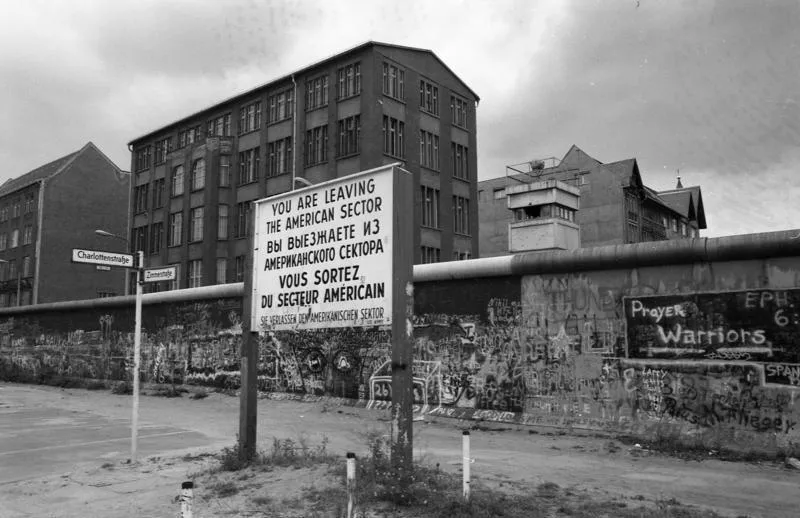
Only the west face of the Berlin Wall was painted. The Wall stood a few metres inside East Germany, and behind it lay a guarded strip nobody could approach. From 1984, artists such as Thierry Noir, Christophe Bouchet and Kiddy Citny covered the western side in colour. After 1990, the painting moved to the East Side Gallery.
This post explains why only one side was painted, who painted it, what happened to the paintings after 1989, and where you can still see them.
Why was only the west side painted?
The Wall did not sit exactly on the border. According to Tate, it stood "a couple of metres inside the East German border", so anyone painting its west face had technically crossed into East Germany.
The east side was another world. Behind the Wall ran a guarded border strip that nobody was allowed to enter. East Berliners could not get near it, so the art faced West Berlin. Noir writes that he played cat and mouse with the border guards for hours, and always jumped back into West Berlin before they could reach him.
Who painted the Wall first?
Thierry Noir, a French artist, lived in West Berlin with his friend Christophe Bouchet, about five metres from the Wall. His site dates their first painting to 16 April 1984: two dogs looking at a medal. They also hung a urinal on the Wall, as a tribute to Marcel Duchamp, until border guards took it away. Noir is often credited as the first artist to paint the Wall, and his own site says so.
Kiddy Citny, a West Berlin artist, painted kings and hearts with them. He wanted to make the "grey, ugly West-side wall colorful", and PBS says he began with his two friends, so accounts of who started differ. Paintings by Noir and Citny along Waldemarstraße appear in Wim Wenders' film Wings of Desire, shot in 1987.
Keith Haring at Checkpoint Charlie, 1986
On 23 October 1986, Keith Haring painted the Wall next to Checkpoint Charlie, for a project of the Haus am Checkpoint Charlie museum. Its staff first covered the section in yellow, over Statues of Liberty that Noir and Bouchet had painted three months earlier. Noir says Haring apologised.
Haring then painted linked figures in black, red and yellow, the colours of both German flags, along about 100 metres in four to six hours. That night or the next morning, someone painted large parts of it grey. Nothing of it remains today except photos.
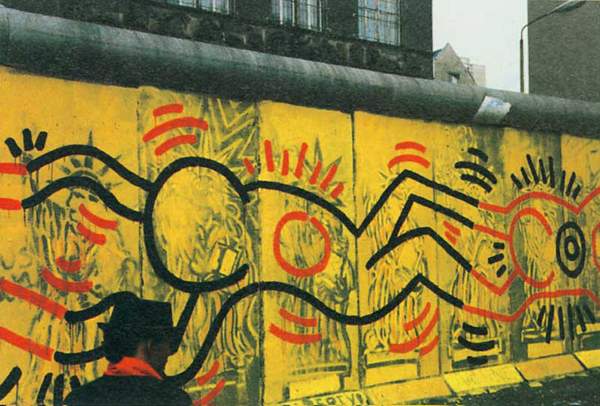 TateLost Art: Keith Haring, Berlin Wall mural 1986
What happened to the paintings in 1989 and 1990?
The Wall opened on 9 November 1989, and its painted segments became objects for sale. In June 1990, 81 segments were offered at an auction in Monte Carlo, and some sold for large sums. Noir writes that pieces with his paintings were sold and that he received nothing.
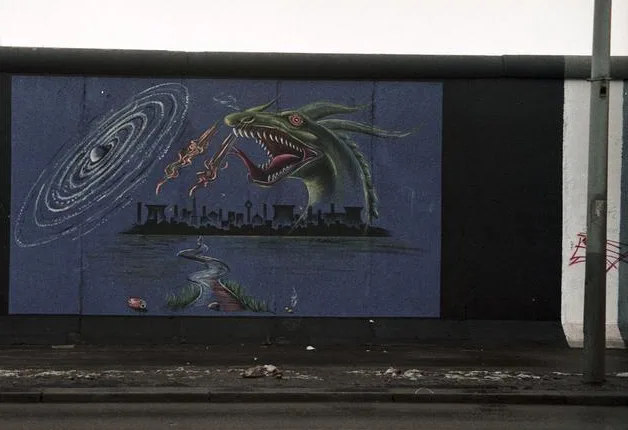
On the east side, painting was now possible. In 1990, 118 artists from 21 countries painted the side of the Wall that had faced East Berlin, along the Spree. The East Side Gallery opened on 28 September 1990; at 1,316 metres, it is the longest section of the Wall still standing. Its most photographed work is Dmitri Vrubel's kiss between the Soviet and East German leaders Leonid Brezhnev and Erich Honecker.
Why was the East Side Gallery repainted in 2009?
The concrete under the paintings was crumbling, and repairs in 1996 and 2000 only fixed parts of it. In 2008 and 2009, the paintings were sandblasted off, the concrete was repaired and primed white, and the artists were invited to paint their works again, according to the Berlin Wall Foundation. It counts 82 artists who repainted, 17 works copied by others and 5 artists who refused a copy, leaving their segments whitish grey. Other counts differ: visitBerlin says 87 artists took part.
Money split the artists. The city offered 3,000 euros per artist, and some asked for five times that. Bodo Sperling led a group of about a dozen boycotting artists, and in 2011 he took the city to court over his work, removed and repainted without his consent.
Only one painting kept its 1990 surface: Hands, by Margaret Hunter and Peter Russell. Everything else you see today is a 2009 version.
 The LocalArtists give Berlin Wall murals anniversary makeover
 The LocalEast Side Gallery artists sue over Berlin Wall restoration
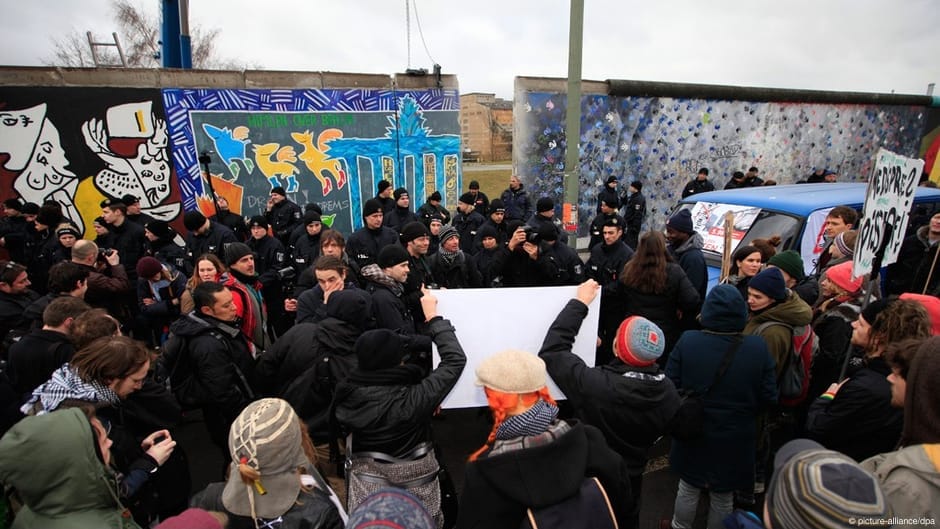 DWEast Side Gallery saved
Where can you see Berlin Wall art today?
At the East Side Gallery, the Foundation removes new graffiti quickly, so please do not add yours to the paintings.
Why it matters on the wall
The Berlin Wall is the clearest case of what happens to street art. The 1980s west face is gone, Haring's mural lasted a night, and the East Side Gallery you visit is a careful copy of 1990. Photos and dated records are what kept each version.
That is why this app keeps archives. You check in at the real wall, within 150 m, and add what you see. When a wall is painted over, moved or repainted, it stays in the archive as Gone, Moved or Damaged, with its story and its dates.
Last checked: 18 November 2026: opening hours, admission and every source below.
Sources
- The Berlin Wall, history, Berlin Wall Foundation (seen 18 November 2026)
- The Berlin Wall, The story of the Berlin Wall and Christophe E. Bouchet, Thierry Noir (seen 18 November 2026)
- History of graffiti, the 1980s and 1990s, STRAAT museum (seen 18 November 2026)
- Berlin Wall paintings survive as symbols of hope 25 years later, PBS NewsHour (seen 18 November 2026)
- Overcoming the Wall by painting it, 23 October 1986, German History in Documents and Images (seen 18 November 2026)
- Lost Art: Keith Haring, Tate (seen 18 November 2026)
- Monaco, The Wall Net (seen 18 November 2026)
- East Side Gallery, Chronicle of the Wall (seen 18 November 2026)
- East Side Gallery, visitBerlin (seen 18 November 2026)
- The Berlin Wall: a visit to the East Side Gallery, DW News (seen 18 November 2026)
- Preserving the East Side Gallery and The debate around the gallery, Berlin Wall Foundation (seen 18 November 2026)
- Berlin bei Nacht, Berlin Wall Foundation (seen 18 November 2026)
- Rebuilding the Berlin Wall, The World (seen 18 November 2026)
- Artists give Berlin Wall murals anniversary makeover and East Side Gallery artists sue over Berlin Wall restoration, The Local (seen 18 November 2026)
- East Side Gallery saved, DW (seen 18 November 2026)
- Information for your visit, Berlin Wall Foundation (seen 18 November 2026)
- The Berlin Wall in the world, deutschland.de (seen 18 November 2026)
- Photos: Bundesarchiv B 145 Bild-F078995-0008, B 145 Bild-F078996-0006 and B 145 Bild-F086694-0029, Wikimedia Commons (seen 18 November 2026)
Related: A short history of graffiti · What happens when a mural is painted over · How to document street art before it disappears