How to document street art before it disappears
Updated
To document a mural, record five things: a straight, sharp photo of the whole wall, its exact location, the artist if you know them, the date, and its condition. In the app you add all five in one go, and every later visit adds a new check, so the wall keeps a history even after it is gone.
This post walks you through 4 steps. It's free, and all you need is a phone.
Why it matters
A shutter is repainted, a building comes down, a new piece goes over an old one. Many murals last only a few years, and often nobody kept a photo with a date and a place. Researchers, urban planners and historians need exactly that: what was on this wall, when, and who painted it. A city's street art is a record of the city itself.
1. Photograph the wall

Stand back until the whole wall fits, straight on, then take close-ups of what a wide shot loses: a signature, a date painted in a corner, a detail. Daylight without flash gives true colours; overcast days are best. Keep people's faces out of the frame.
If the wall is long, shoot it in overlapping parts from left to right. Note what surrounds it if it matters: the shop it belongs to, the building it covers.
2. Add it to the archive
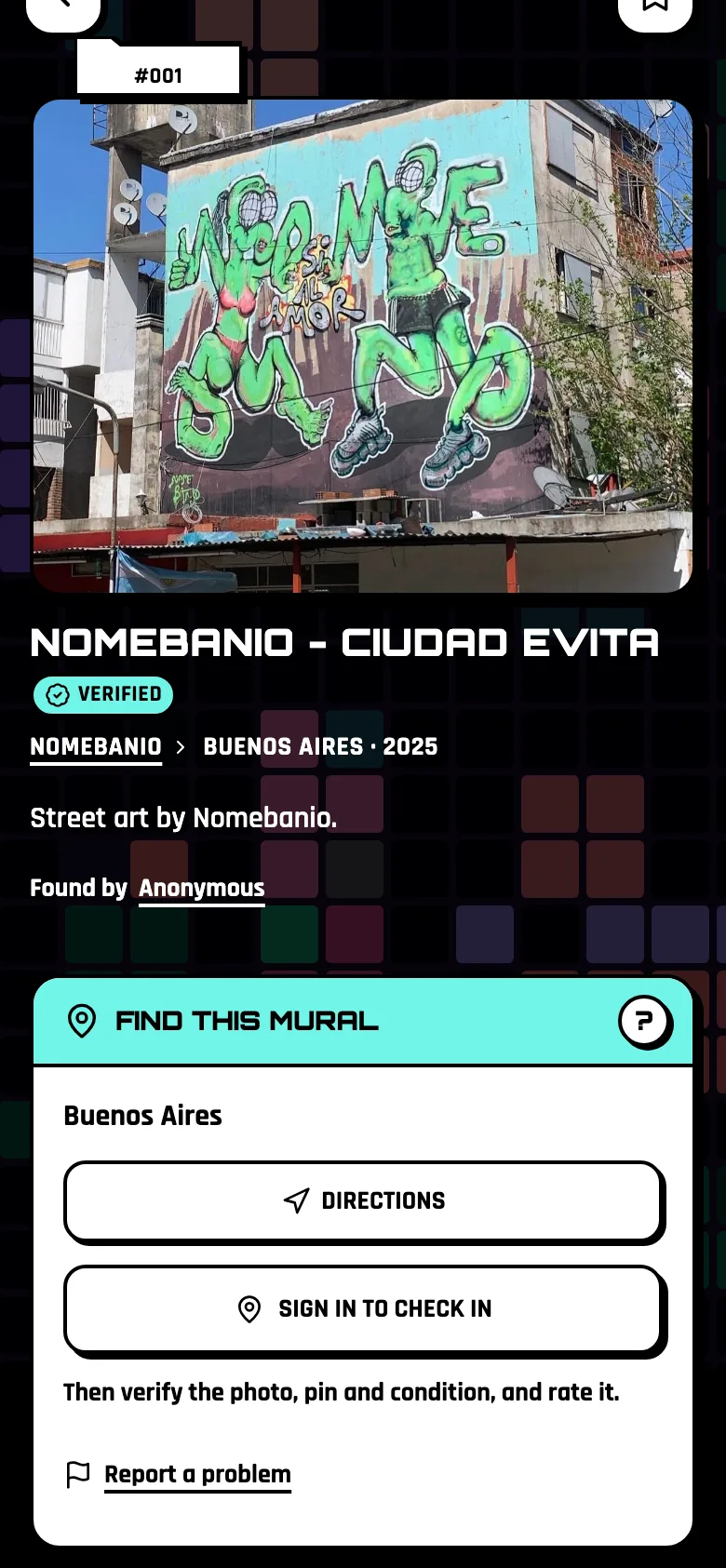
Go to Murals, then Add (or Scan a wall in the quick actions). Add the photo, let your GPS pin the wall from where you stand in front of it, and add the artist if you know them. If you don't, leave it empty: someone who knows will add it, and a wrong name is worse than none.
Painted at a festival? Pick At a festival: the wall joins that festival's archive with its edition.
Each mural gets its own archive page, with its number, its photo, the artist, the city, the year and who found it.
3. Check it, again and again
Documenting is not one visit. Every check-in at the wall (within 150 m) asks the quick checks: is the photo right, is the location right, is the artist credited correctly, is it still there, damaged or gone? When several people confirm a mural, it gets its Verified badge.
A gone wall is never deleted. Its photo, date, place and artist stay on record. That is the point of the archive.
4. Do it with others

A street is easier to cover with five people than alone. Start or join a crew for your district, pin a list of walls to check this month, and split the streets. The Build the archive quest path follows your work: add walls nobody has documented, and the last title on it is Guardian of the Archive.
Your challenge
Pick one street you know. Document every wall on it this week, then check them again in a month. You will be surprised how many changed.
Start documenting
Open the app, tap Scan a wall, and add the first one.
Last checked: 17 November 2026, on the web app in English.
Related: What happens when a mural is painted over · Street art crews · How to hunt street art