Muralism in Latin America: from Mexico's walls to today's streets
Updated
Latin American muralism began in Mexico in the early 1920s, when the state paid artists to paint the country's history on public buildings. From there it travelled the continent: to Los Angeles, Buenos Aires, Chile's brigades and 1980s Nicaragua. Today it lives on in the streets, from graffiti to festivals. It was almost always public and political, and often painted over.
This post visits 8 countries.
1. Before 1921: much older walls
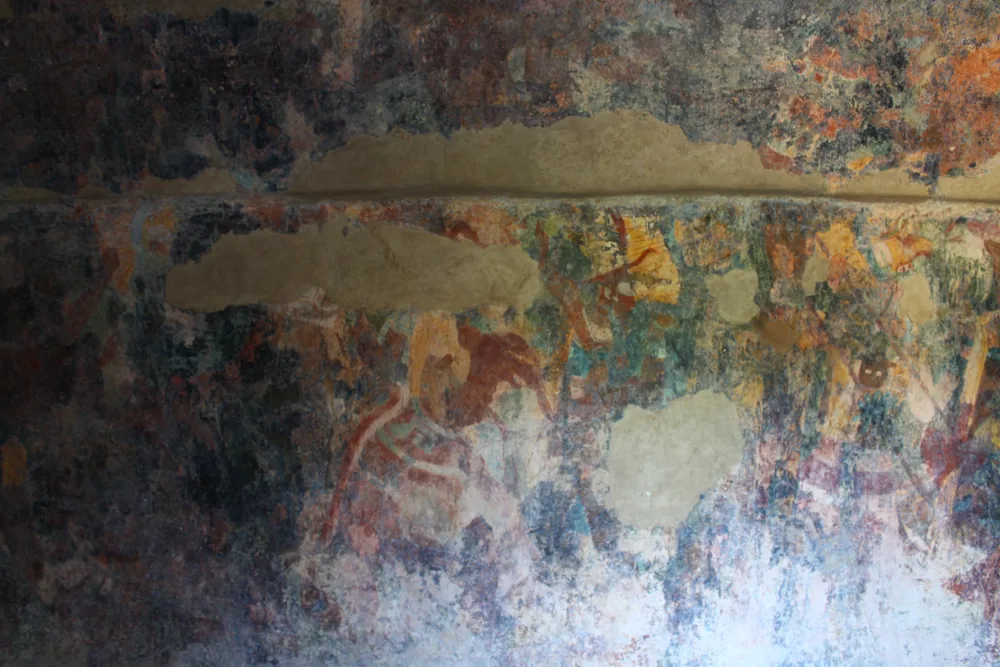
In the Americas, walls were painted centuries before Rivera. At Bonampak, in Chiapas, three Maya rooms painted in the late 8th century show a procession, a battle with captives and a celebration (INAH). Teotihuacan also has houses with painted walls. Look at the bare patches in the photo: even in a temple, paint gets lost.
2. Mexico, the laboratory (1921 to 1951)
José Vasconcelos, the education minister, called on artists to paint public buildings. At the former Colegio de San Ildefonso, Roberto Montenegro painted the movement's oldest work in 1921, but it truly starts with Diego Rivera's La creación, in 1922. José Clemente Orozco and David Alfaro Siqueiros worked there too, and about 40 more works were painted by 1926.
The idea: a history book on the wall, paid for by the state, in buildings anyone can walk into. Next came the Ministry of Public Education, now the Museo Vivo del Muralismo, and the staircase of the National Palace, which Rivera painted from 1929 to 1951.
3. Siqueiros travels: Los Angeles and Buenos Aires
In 1932, Siqueiros painted América Tropical on Olvera Street, Los Angeles: an Indigenous man tied to a double cross under an American eagle. Within months it was partly covered, and within a decade completely. The Getty and the city conserved it, and it went back on view on 9 October 2012, 80 years later.
In 1933, in Argentina, he painted Ejercicio Plástico in a basement, with Antonio Berni, Lino Enea Spilimbergo and Juan Carlos Castagnino. When the house changed hands, the mural was cut into six parts and spent years stored in containers. Since 3 December 2010 it can be seen at the Museo Casa Rosada in Buenos Aires.
4. Chicano murals: muralism changes hands
In the 1970s, Mexican muralism crossed the border and passed into the hands of neighbourhoods. In San Diego, Barrio Logan residents painted Chicano Park under a bridge, and in Los Angeles, Judy Baca and more than 400 young people painted the Great Wall. The politics were the same as in Mexico, but the painters were new.
5. Chile: brigades, erasures and protest
The Brigada Ramona Parra, founded in 1968 by young communists, painted fast, collective murals in flat colours. After the coup of 11 September 1973, the military covered their murals, and the brigade kept painting underground: what was painted at the weekend was erased on Monday.
In Valparaíso, the Open-Air Museum on Cerro Bellavista opened in 1992 with 20 murals, one of them by Roberto Matta; today it is nearly abandoned and has already lost two. In Santiago, in February 2020, the facade of the GAM cultural centre, covered in art from the 2019 protests, was painted over.
6. Nicaragua: the murals of the revolution
After 1979, Managua filled with murals. In late 1990, city workers painted over the Simón Bolívar mural and others, and artists blamed the mayor. It is one of the clearest cases of a whole era of murals erased by a change of government.
7. Today's streets
- Brazil: in São Paulo, pixação grew in the 1980s, with tall, jagged letters. A 2011 law separates grafite, legal with the owner's consent, from pichação, which is still a crime. The same streets produced Os Gêmeos.
- Colombia: in Bogotá, the 2011 case of Diego Felipe Becerra, a young graffiti writer, changed the city's approach. In 2013 it chose to regulate graffiti instead of banning it, and in 2023 the state publicly apologised. In Medellín, in July 2026, 61 of the 69 murals on the Comuna 13 tour were fully or partly hidden by stalls and shops.
- Argentina: Buenos Aires has regulated street art since 2009 and asks for the owner's approval. In Barracas, Marino Santa María covered the houses of Pasaje Lanín in colour and mosaic.
- Puerto Rico: from 1949, DIVEDCO made silkscreen posters the island's graphic art. Today the Santurce es Ley festival paints Calle Cerra in San Juan.
- Peru: in 2015, Lima's city hall painted over murals in the historic centre, and residents protested with #SalvemosLosMurales.
Where to see them today
Check opening hours and tickets on each place's site before you go.
Why it matters
Many of these walls now exist only in photos. That is why we keep them in an archive: the photo, the date, the artist and the story of each mural, even if it is covered tomorrow. Live in one of these cities? Photograph the murals in your neighbourhood and add them.
Last checked: 18 November 2026, on the pages linked below.
Sources
- San Ildefonso, cuna del muralismo mexicano, Gaceta UNAM (seen 18 November 2026)
- Aurora Reyes and the abuse of women after the revolution, Gaceta UNAM (seen 18 November 2026)
- Bonampak, INAH (seen 18 November 2026)
- América Tropical conserved and now on view, Getty (seen 18 November 2026)
- Ejercicio Plástico, Página/12 (seen 18 November 2026)
- The Chilean muralists who defied Pinochet, BBC Mundo (seen 18 November 2026)
- Mural madness, Envío (seen 18 November 2026)
- Lei nº 12.408, Câmara dos Deputados (seen 18 November 2026)
- Public apology for the killing of Diego Felipe Becerra, Bogotá city hall (seen 18 November 2026)
- Murals hidden in Comuna 13, El Colombiano (seen 18 November 2026)
- Arte urbano, grafitis y murales, Buenos Aires tourism (seen 18 November 2026)
- Santurce es Ley, Diálogo UPR (seen 18 November 2026)
- Lima mayor orders murals destroyed, Hyperallergic (seen 18 November 2026)
Related: A short history of murals · A short history of graffiti · Street art festivals 2027